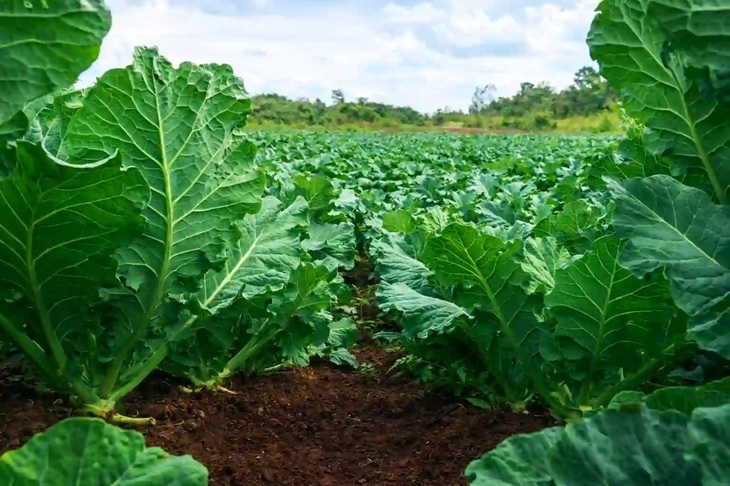

For families who lean on sukuma wiki as a cheap, everyday vegetable, none of this is just academic. Where you shop can genuinely make a difference to the household budget.
Bulk and wholesale purchases can attract different rates altogether, and with a commodity like sukuma wiki, prices can shift quickly depending on supply and demand on any given day.
According to a spot check by the Business Watch, sukuma wiki is currently retailing at KSh53.43 per kilogram across the Kenyan markets, as 50kg going at KSh2,672 on average.
Across the markets tracked in the data, the same 50kg equivalent could set you back anywhere from about KSh600 to a staggering KSh5,000, depending purely on location.
Price of 50kg of Sukuma Wiki per County
| COUNTY | MARKET | RETAIL PRICE PER KG | ESTIMATED COST OF 50KG |
| Taita-Taveta | Voi | KSh100 | KSh5,000 |
| Kisumu | Ahero | KSh100 | KSh5,000 |
| Migori | Isebania | KSh80 | KSh4,000 |
| Kwale | Kinango | KSh80 | KSh4,000 |
| Kwale | Diani | KSh80 | KSh4,000 |
| Kakamega | Mumia | KSh71.43 | KSh3,571.50 |
| Kisumu | Kibuye | KSh70 | KSh3,500 |
| Kirinyaga | Kutus | KSH60 | KSh3,000 |
| Taita-Taveta | Mghange | KSh50 | KSh2,500 |
| Kirinyaga | Makutano | KSh50 | KSh2,500 |
| Meru | Maua | KSh50 | KSh2,500 |
| Kisumu | Katito | KSh50 | KSh2,500 |
| Meru | Kangeta | Ksh40 | KSh2,000 |
| Kisumu | Muhoroni | Ksh40 | KSh2,000 |
| Bomet | Ndanai | KSh30 | KSh1,500 |
| Kwale | Lungalunga | KSh20 | KSh1,000 |
| Kirinyaga | Kagio | KSh12 | KSh600 |
Topping the list are Voi in Taita-Taveta and Ahero in Kisumu, both recording KSh100 per kilogram, which works out to about KSh5,000 for 50kg. Not far behind, Isebania in Migori and the Kwale markets of Kinango and Diani came in at KSh80 per kilo, or roughly KSh4,000 for the same quantity.
Kagio in Kirinyaga posted the lowest price by far, at just KSh12 per kilogram, meaning 50kg there would cost around KSh600, a fraction of what buyers in Voi or Ahero are paying for the same amount.
What’s striking is that you don’t even need to cross county lines to see this kind of gap, it shows up within counties too.
Ahero in Kisumu sits at KSh100 per kilo, Kibuye at KSh70, Katito at KSh50, and Muhoroni at KSh40. That’s a 50kg range running from KSh2,000 all the way to KSh5,000, all within the same county.
Kagio’s in Kirinyaga, a kilo is going for KSh12, sitting far below Kutus at KSh60, a difference that translates to KSh600 versus KSh3,000 for 50kg.
Meru shows smaller but still notable gaps, with Maua at KSh50 per kilo against Kangeta’s KSh40. Worth noting too, Mkulima Bora’s historical records show Maua’s prices had already crept up from KSh40 to KSh50 per kilo between April and May 2026, so this isn’t necessarily a one-off spike
Markets sitting closer to growing areas tend to get better prices when supply is strong, while markets that depend on produce hauled in from elsewhere often pass that extra transport cost on to buyers.
There’s also a wholesale-retail gap worth flagging. In Maua, a wholesale price is going for KSh25 per kilo against a retail price of KSh50, meaning the price effectively doubles by the time it reaches the consumer.
Related Content: When Did The Price Of Tissue Paper Hit Ksh 500 In Kenya?