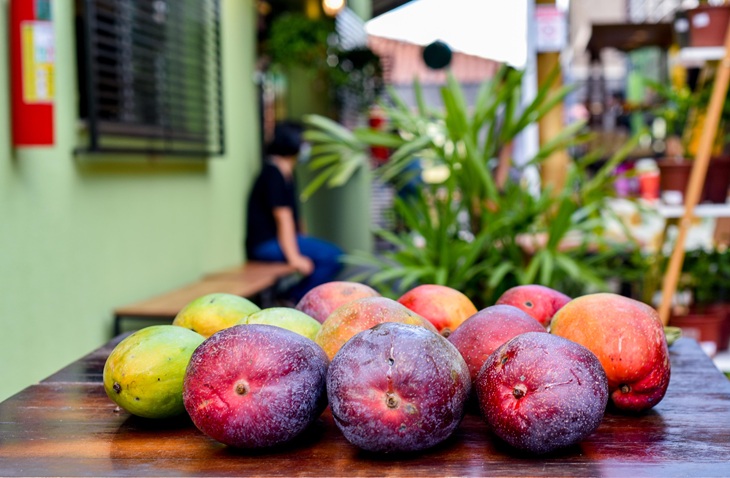

Walk into a market in Mombasa this month, and you might pay as little as KSh13 for a kilo of mangoes. Head to Kibuye Market in Kisumu, and that same kilo could set you back KSh150.
Same country, same fruit, wildly different prices, and the gap tells a bigger story about what’s happening to Kenya’s mango supply right now.
In Nairobi, ordinary local mangoes are going for around KSh25 a kilo, while the prized Ngowe variety fetches more than double that at roughly KSh55.
Eldoret’s West Market is even cheaper, at about KSh20. But travel west and the picture changes dramatically: Sabatia in Kakamega is charging around KSh100 per kilo, and Wundanyi in Taita-Taveta sits at about KSh50.
| Market | Price per Kg |
| Kibuye Market, Kisumu | KSh150 |
| Sabatia, Kakamega | KSh100 |
| Nairobi – Ngowe | KSh55 |
| Wundanyi, Taita-Taveta | KSh50 |
| Nairobi – Local | KSh25 |
| Eldoret West Market | KSh20 |
| Mombasa | KSh13 |
Prices reflect market reports from September 2026 and shift with variety, quality, and whether fruit is sold wholesale or retail.
Mango trees are picky about conditions during flowering and fruit-setting, skimp on rain at the wrong moment, and the harvest shrinks before it even has a chance to grow. Market watchers have pointed to exactly this kind of rainfall disruption as a driver of the current squeeze.
In Makueni, one of Kenya’s mango heartlands, farmers are still battling the false codling moth. One grower told The Guardian she lost over 60% of her harvest to the pest back in 2016, before she switched to integrated pest management.
Kenya’s mango production clusters around specific counties and seasons, so any region that leans on imported supply from elsewhere feels the pinch fast when those source areas underperform.
Earlier in 2026, Murang’a County had the opposite problem, a glut so severe that farmers couldn’t sell their mangoes fast enough before they rotted.
That contradiction- abundance in one county, scarcity in the next, exposes a weak link in Kenya’s mango trade, fruit isn’t moving efficiently between regions. It’s less a production problem and more a logistics one, tied up in storage, transport, and how well markets are connected.
Makueni County is trying to fix its end of that chain, pushing farmer cooperatives, better aggregation systems, contract farming, and more pack houses. Officials are also eyeing export opportunities abroad, including in Oman.
The wide price swings aren’t random; they largely trace back to distance. Markets near production zones get their mangoes cheap and fresh.
Towns further out absorb the cost of fuel, handling, and spoilage along the way, and that shows up on the price tag. Variety matters too: a Ngowe mango can cost twice as much as an ordinary one sold a few stalls down.
Kenya isn’t short on mangoes overall; the country produced an estimated 783,000 tonnes in 2024, with about 25,039 tonnes exported. The real issue is distribution: getting fruit from a glutted county to a scarce one before it spoils.
Investment in cold storage and processing (juice, pulp, and other mango products) could help even things out, giving farmers somewhere to put surplus fruit instead of watching it rot.
For now, though, shoppers in different parts of the country are living in two different mango economies and where you stand in that divide comes down largely to how far your market is from the nearest farm having a good season.
Related Content: As Mango Season Peaks, Potato Prices Hold Steady Across Kenyan Markets