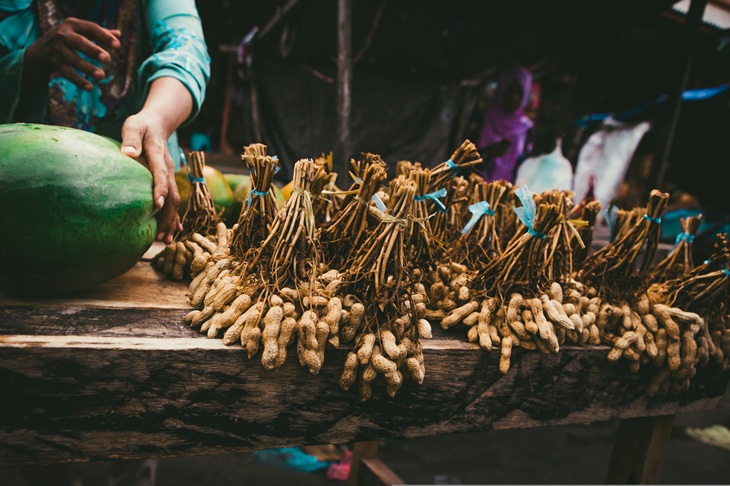

If you’ve priced groundnuts recently in more than one town, you’ve probably noticed something odd, the numbers don’t line up at all. A kilo that goes for under KSh200 in one market can fetch nearly double that a few counties over.
The gap between the cheapest and priciest groundnuts in the country right now runs into thousands of shillings on a single 90kg bag.
Nationally, retail groundnuts are averaging around KSh280.59 a kilo, with wholesale sitting noticeably lower at about KSh159.99. The steepest price anyone paid, based on the latest data, was in Muhoroni, Kisumu County, where a kilo touched KSh375.
Do the math on a full 90kg sack and you’re looking at anywhere from roughly KSh18,000 on the low end to KSh33,750 at the top, for what is, broadly speaking, the same product.
At Kangemi, large brown groundnuts were changing hands at KSh220 a kilo, which works out to about KSh19,800 for a full bag. Head out to Kagio in Kirinyaga and the picture looks friendlier: KSh170 wholesale, KSh200 retail. That’s roughly KSh15,300 to KSh18,000 for 90kg, among the more affordable options going.
Taveta, over in Taita-Taveta, sat in the middle of the pack, KSh240 wholesale and KSh300 retail per kilo, putting a bag at somewhere between KSh21,600 and KSh27,000.
Then there’s Kisumu County, which dominates the higher end of the scale almost across the board. In Holo, large brown groundnuts were fetching KSh325 retail and KSh266.67 wholesale about KSh29,250 and KSh24,000 respectively for 90kg.
Ahero wasn’t far behind, with wholesale ranging KSh250–300 and retail KSh275–325 a kilo, so a bag there could run anywhere from KSh22,500 to KSh29,250 depending on which end of that range you hit.
Muhoroni is where things get genuinely steep. Wholesale groundnuts were going for KSh275 a kilo (about KSh24,750 for a bag), while retail hit KSh350, and one recorded entry pushed all the way to KSh375, which prices a 90kg bag at KSh33,750. That’s nearly double what the same quantity would cost in Kagio.
Kibuye Market, also in Kisumu, showed just how much variety matters within a single location. Large brown groundnuts were going for KSh280 a kilo (about KSh25,200 a bag), but small red groundnuts at the very same market climbed as high as KSh350 a kilo, KSh31,500 for 90kg.
| MARKET | PRICE PER KG | PRICE PER 90KG |
| Kagio, Kirinyaga (wholesale) | KSH 170 | KSH 15,300 |
| Kagio, Kirinyaga (retail) | KSH 200 | KSH 18,000 |
| Kangemi, Nairobi (retail) | KSH 220 | KSH 19,800 |
| Taveta (wholesale) | KSH 240 | KSH 21,600 |
| Taveta (retail) | KSH 300 | KSH 27,000 |
| Holo, Kisumu (wholesale) | KSH 329 | KSH 29,500 |
| Muhoroni, Kisumu (wholesale) | KSH 275 | KSH 24,000 |
| Muhoroni, Kisumu (retail) | KSH 350 | KSH 31,500 |
| Muhoroni, Kisumu (retail, high) | KSH 375 | KSH 33,750 |
| Kibuye, Kisumu (retail) | KSH 280 | KSH 25,200 |
| Kibuye, Kisumu (retail, small red) | KSH 350 | KSH 31,500 |
None of this is random, variety plays a big role, small red groundnuts and large brown ones rarely sell for the same price even at the same stall, so grading and presentation genuinely affect what a farmer walks away with.
Supply, demand and simple distance from the growing areas do the rest. For farmers weighing where to sell, that spread looks like an obvious opportunity: find the market paying more, take your produce there, pocket the difference.
In practice it’s rarely that clean. Transport costs eat into the gain fast, and once you factor in handling, storage and market fees, a “better” price on paper doesn’t always translate into more money in hand. Farmers who can bypass middlemen and sell closer to wholesale-to-retail buyers directly tend to come out ahead, everyone else is often just trading one set of costs for another.
Either way, for anyone buying or selling a 90kg bag this month, it’s worth checking more than one market first. The difference between the cheapest and priciest options on this list alone is over KSh18,000.
Related Content: Banseok Industry Donates Peanut Peeling Machines To 5 Counties