
Stephen Otieno Oloo walked to work the way he always did, in the dark, before the city woke up. It was a Sunday, just after five in the morning. He was a watchman, the kind of man whose job is to keep other people safe through the night. Nobody was watching over him.
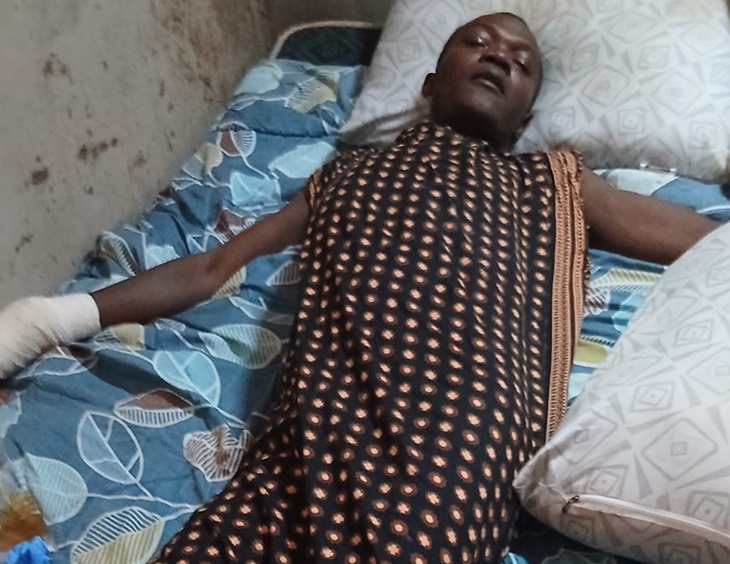
Thieves attacked him on that walk. They beat him with the kind of violence that doesn’t just injure a body; it ends a life as that person knew it. His spinal cord was broken clean in two. A man who left his house on his own two feet would never walk on them again.
What happened to Stephen next should shame every institution that touched his case.
He was rushed to Westlands Specialist Hospital. For two days, his family watched a bill climb to Ksh 200,000, a fortune for a family surviving on a watchman’s wage. No surgery was performed. No spine was stabilized. What that money bought, it is hard to say. What it did not buy was help.
Unable to keep up, the family made the only choice left to them: they moved him. To Kenyatta National Hospital, the country’s largest referral facility, the place poor Kenyans are told to trust when private care fails them.
At KNH, nurses were on strike. Stephen, a man with a broken spinal cord- one of the most time-critical injuries a human body can suffer, was left in a hospital lobby for two days. Not a ward. Not an ICU. A lobby.
While he lay there, untouched, his spinal cord was rotting inside him. Every hour that passed was an hour of damage that no surgeon, however skilled, could later undo. This is not a story about bad luck. This is a story about a system that had a man dying in its foyer and could not, or would not, move him.
Jumuia Hospital Huruma: A Rescue, Then a Betrayal
It was a Catholic institution, Jumuia Hospital Huruma, that finally took him in. They agreed to accept SHA to cover part of the cost. They performed the surgery his family had been chasing for days. By every account, the surgery itself was called “successful.”
But Stephen did not wake up.
Two days after surgery, still unconscious, still entirely dependent on the hospital that had just operated on his spine, Jumuia Hospital allegedly threw him out in the middle of the night because his family could not produce Ksh 50,000 to “secure” his bed, with another Ksh 50,000 demanded for every day after.
Read that again. A man who cannot open his eyes. A man who cannot advocate for himself, sign a form, or beg for one more night. And the demand made of his family was not for medicine, not for a specialist, not for continued care, it was for cash, on the spot, in the dark, or he had to leave.
According to the family, there was no transition plan, no ambulance, no coordination with another facility. There was a car, hired in desperation, and a broken man laid across its seats for the long journey to Siaya — not to recover, but, in the family’s own words, to await his death in the village that raised him.
This is a matter of urgent public concern — not because one hospital is being named, but because it should never be possible, in a country with a Constitution that guarantees the right to emergency medical treatment, for an unconscious patient to be discharged onto the street over an unpaid balance.
A Man, Not a Statistic
It is easy for a story like this to become an argument about policy, about SHA, about hospital strikes, about the state of referral care. Those arguments matter. But somewhere in Siaya right now, there is a man named Stephen Otieno Oloo lying in his family’s house, unconscious, his spine held together by a surgery no one is monitoring, waiting on nothing but the mercy of time.
He was a watchman. He guarded gates so that other people could sleep without fear. Nobody guarded him.
What Needs to Happen Now
- Stephen needs to be under continuous medical monitoring, not left in a village home with no post-surgical care for an unconscious spinal patient.
- His case needs the attention of KNH’s administration, the Ministry of Health, and SHA, to establish exactly what happened — the discharge of an unconscious patient over a bed fee is a matter that regulators, not just the family, should be investigating.
- Jumuia Hospital Huruma should be asked, publicly, to explain this discharge — what happened to the SHA cover it had agreed to, and why an unconscious man was removed from care in the middle of the night.
- His family cannot do this alone. They have already spent what they had chasing hospitals that failed him one after another. If you can help with funds, transport to a facility capable of monitoring an unconscious spinal patient, or simply amplifying his story so it reaches someone who can intervene — this is the moment.
Stephen Otieno Oloo is still alive. That single fact is the only reason this story is not yet a eulogy. What happens in the next few days may decide which one it becomes.
Related Content: My Covenant to Defeat Poverty, Restore Dignity and Lead with Godly Purpose In Webuye West – Steve Biko