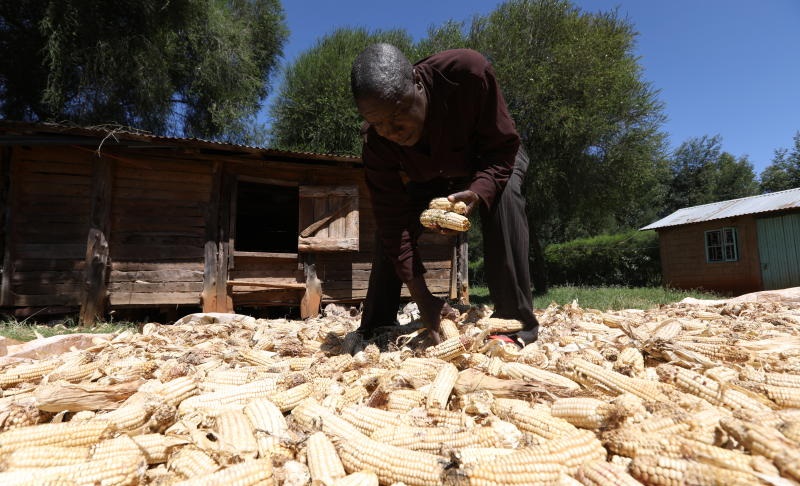

At markets across Kenya, the conversation this month keeps circling back to one thing: the price of unga, and with good reason.
The government now expects maize production to fall by as much as 40 percent this year, which would leave the country short by roughly 5.4 million 90-kilogram bags come September.
Agriculture Cabinet Secretary Mutahi Kagwe has announced plans to import one million bags to shore up the strategic reserve, but for many households, that number feels small next to the size of the problem.
The roots of the shortfall are mostly about weather. In several of the country’s key maize-growing areas, farmers had a decent start to the season, only for the rains to stop just as their crops needed them most. Fertiliser subsidies also arrived late in a number of regions, which didn’t help matters.
For most people, though, the technical explanations matter less than what happens next at the till. Maize is still the food staple for millions of Kenyan households, and ugali remains one of the cheapest ways to keep a family fed.
There isn’t much give in these budgets already, a two-kilogram packet of maize flour was retailing at Sh153 to Sh163 in June, according to figures cited by the CS. If supply keeps tightening, that price is unlikely to hold.
It’s not just consumers who are exposed, farmers who had a poor season are now short on cash right when they need to be buying seed and fertiliser for the next one. That’s how a single bad harvest can end up shaping the one after it too.
Further down the chain, millers, traders and retailers may end up paying more to source and move grain, and institutions that go through a lot of maize, schools, hotels, hospitals, could see their food costs climb as well.
None of this is happening in isolation, either. The Food and Agriculture Organization estimated earlier this year that about 3.7 million people in Kenya’s arid and semi-arid areas were already facing crisis-level food insecurity or worse between April and June.
Maize prices in February were already higher than the year before, partly because of rising fuel costs pushing up transport. Against that backdrop, one million bags of imports look more like a partial fix than a real solution; it covers less than a fifth of the projected gap.
Which means the government will likely be under pressure to consider further imports or lean more heavily on strategic reserves if the domestic picture doesn’t improve.
For millions of Kenyan families, in other words, this isn’t really a story about agriculture. It’s a story about how much food will cost in the coming months, whether farmers can afford to plant again, and how much strain low-income households can absorb before something gives.
How the government handles the next few weeks will matter. Getting maize supplies right isn’t only about keeping markets calm on paper; it’s about what ends up, or doesn’t end up, on the table.
Related Content: Maize Prices Remain High Despite Ongoing Harvest In Most Parts Of The Country