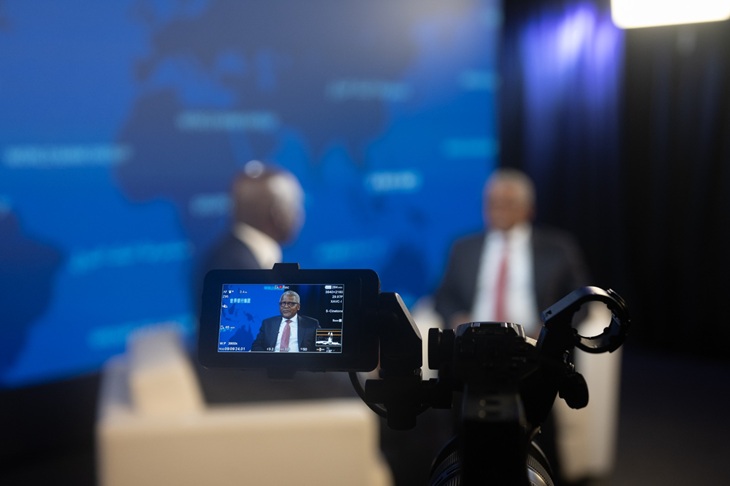

Africa’s richest industrialist, Aliko Dangote, has laid out an ambitious blueprint for transforming the continent’s economic fortunes, calling for bold investments, deeper regional integration, and a shift from rhetoric to execution.
Speaking during a high-level conversation with IFC Managing Director Makhtar Diop, Dangote emphasized that Africa’s long-discussed “potential” must now be converted into tangible economic growth. To drive this agenda, he revealed the formation of the African Renaissance Group, a coalition of like-minded African business leaders committed to crafting and implementing a unified development vision.
“At some point, I asked myself—how do we move from potential to reality?” Dangote said, noting that systemic barriers such as restrictive visa regimes, inefficient border processes, and costly transportation networks continue to stifle intra-African trade.
He cited personal experience, revealing that he requires up to 38 visas to travel across the continent, a challenge he says undermines investment and collaboration. “Without free movement of people, goods, and services, there is no way Africa can prosper,” he added.
Beyond policy bottlenecks, Dangote highlighted structural inefficiencies in logistics and aviation, where moving goods within Africa can be more expensive than shipping from Europe. Similarly, high airfares across short regional routes continue to limit mobility and business expansion.
Central to Dangote’s vision is industrialisation, exemplified by his $20 billion refinery project in Nigeria. The refinery, now operating at a capacity of approximately 650,000 barrels per day, was conceived to address Africa’s long-standing paradox of exporting crude oil while importing refined petroleum products.
“At the time we started, no African country—except a few—had sufficient refining capacity. We had to change that,” he said, adding that the project faced skepticism from global industry players who doubted its feasibility.
Dangote underscored that the refinery’s success demonstrates the importance of African-led investment. “If we don’t invest our own money, we cannot convince others that Africa is worth investing in,” he said.
Looking ahead, the Dangote Group is expanding aggressively into key sectors critical to Africa’s development. These include fertiliser production—where the company aims to become the world’s largest producer with 12 million tonnes of urea—mining of potash and phosphate, power generation targeting 20,000MW, LNG projects, and the construction of a major deep-sea port.
He also stressed the need for Africa to shift from exporting raw materials to value addition, citing cocoa as a prime example. “Africa produces 80% of the world’s cocoa, yet exports it in raw form. Processing it locally would significantly boost value and incomes,” he noted.
In a move aimed at democratizing wealth creation, Dangote revealed plans to list parts of his business empire, including the refinery, and invite Africans to invest. He projected that the group could generate up to $100 billion in revenue, with potential dividends of $20–25 billion—funds he believes could transform lives across the continent.
“This is about creating quality assets that Africans can invest in. If returns are strong and stable, people will invest locally instead of taking capital abroad,” he said.
Beyond industry, Dangote highlighted water infrastructure and agriculture as critical levers for inclusive growth. He pointed to plans to rehabilitate over 400 dams in Nigeria, which could unlock irrigation, boost food production, and create jobs—particularly in conflict-prone regions.
“Agriculture is no longer a poor man’s business. It is the fastest way to create jobs and lift people out of poverty,” he said, projecting that the group’s agricultural expansion could increase its workforce from 51,800 to over 200,000.
Makhtar Diop echoed Dangote’s sentiments, emphasizing the World Bank Group’s commitment to supporting Africa’s industrialisation through partnerships with private sector leaders. He noted that sustainable development will require coordinated efforts between governments, financiers, and entrepreneurs.
The conversation underscored a shared belief: Africa’s transformation will not come from external solutions alone, but from bold, homegrown investments backed by strong institutions and visionary leadership.
Related Content: Dangote Industries shows its commitment to empowering Africa