

It’s a random Tuesday, you’re hustling at your kiosk, salon, boda boda stage, or freelance gig, and retirement feels like a problem for “future you” to solve. But here’s the thing: future you is being built right now, one contribution at a time.
That’s exactly what the National Social Security Fund (NSSF) voluntary membership is for: giving Kenya’s self-employed and informal sector workers a real shot at a dignified retirement, without needing a formal employer to make it happen.
If you’ve ever wondered how a jua kali artisan, a market trader, or a freelance graphic designer builds a pension, this one’s for you.
Who Can Join as a Voluntary Member?
If you’re self-employed, whether you run a business, work as a consultant, farm, or hustle in the gig economy, you don’t need to wait for an employer to enroll you. NSSF opens its doors to anyone willing to save consistently for their future, on their own terms.
Step 1: Walk Into an NSSF Office
Registration starts with a simple in-person visit. Head to the [NSSF office nearest to you](https://www.nssf.or.ke/branches/) with:
- Your National ID, Alien Card, or Passport
- A photocopy of that document
No mountains of paperwork, no complicated forms — just the basics to get you into the system.
Step 2: Get Registered
Once you’re at the counter, an NSSF officer will capture your details and officially register you as a voluntary member. At this point, you’re no longer just a hustler but a saver with a plan.
Step 3: Activate Your Membership
Here’s where it gets real. You’ll need to pay a minimum initial contribution of KES 200 to activate your account. This isn’t just an activation fee that disappears but becomes the very first entry on your contribution statement. Your retirement savings journey officially begins with that KES 200.
Step 4: Receive Your NSSF Membership Card
Congratulations! You’re in! You’ll be issued an NSSF membership card, your proof of membership, and a handy reference for future transactions. Keep it safe, as losing it incurs a replacement fee of KES 200.
Step 5: Top Up Anytime, Anywhere via USSD
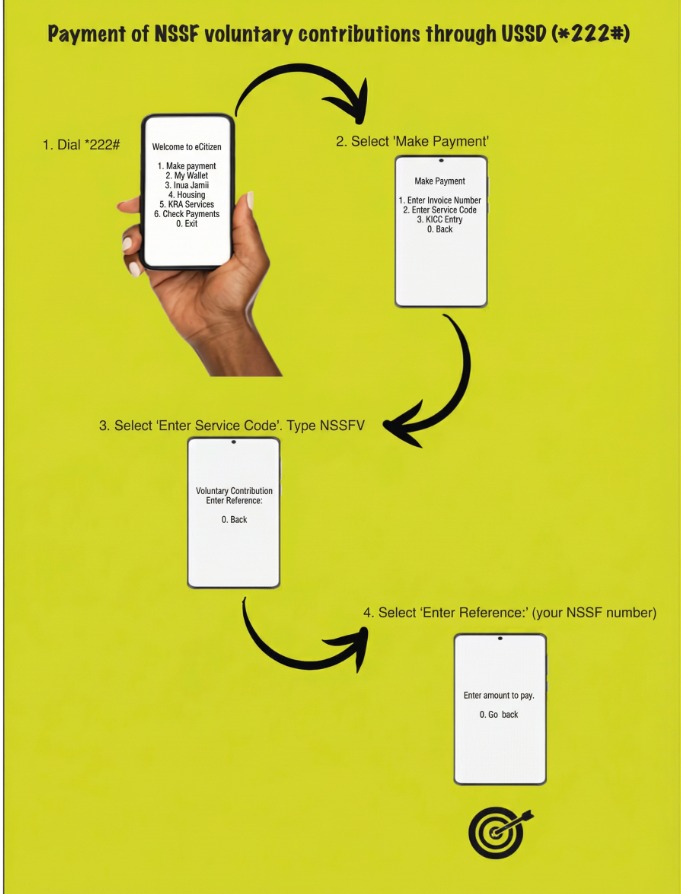
This is the part that makes voluntary saving genuinely doable for busy people. You don’t have to visit a branch every time you want to contribute. NSSF lets you top up straight from your phone using M-PESA through the USSD code *222#. Here’s how it works:
- Dial *222#. This opens the eCitizen menu with options such as Make Payment, My Wallet, Inua Jamii, Housing, KRA Services, and Check Payments.
- Select “Make Payment”, then choose to enter your Invoice Number, Enter Service Code, or do a KICC Entry.
- Select “Enter Service Code” and type in NSSFV (the code for voluntary contributions), then enter your reference.
- Enter your Reference. This is your NSSF number, followed by the amount you’d like to contribute, and confirm to complete payment via M-PESA.
Just like that, from wherever you are, market stall, matatu, or your living room, you’ve contributed to your golden years.
Why This Matters
Social security shouldn’t be a privilege reserved for people with formal 9-to-5 jobs. Kenya’s informal sector is the backbone of the economy, and voluntary NSSF membership is a bridge that lets anyone build long-term financial security, contribution by contribution, no matter how small.
Think of it less like a bill and more like a habit, the same way you might save daily in a chama or table banking group. Except this one comes with the backing of a national pension fund, and it grows quietly in the background while you focus on running your hustle.
Becoming an NSSF voluntary member takes one office visit and KES 200 to get started. After that, it’s as easy as dialing *222# whenever you have a little extra to set aside. Small, consistent contributions today are the foundation of comfort and independence tomorrow.
So the next time you have a good sales day, or that freelance invoice finally clears — consider sending a little something toward your future. Dial *222#, and pay yourself first.
Related Content: A Court That Corrected Itself: What the Setting Aside of the May 29 NSSF Ruling Means for Millions of Kenyan Workers