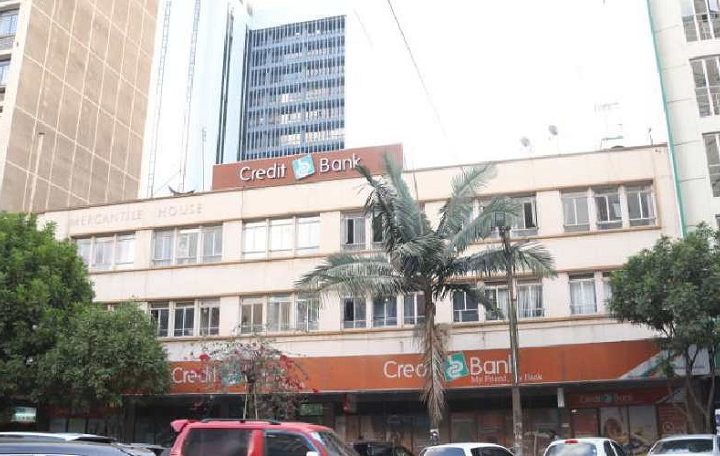

Credit Bank has come under sharp scrutiny from both the public and stakeholders after being accused of seizing a parcel of land in Nairobi’s upmarket Loresho area in defiance of a High Court injunction barring any sale, transfer, or occupation of the property.
The dispute, which is rapidly turning into a legal and reputational quagmire, paints a grim picture of a lender grappling with deep financial distress while allegedly cutting corners to salvage its balance sheet.
The bank is currently grappling with bad loans that are threatening to sink in, and in a desperate attempt to salvage the sinking ship, the lender has been using unscrupulous means to recover loans without following the law or putting the customers into consideration.
According to documents and witness accounts reviewed by legal representatives, the bank and certain individuals purportedly linked to it went ahead with a transfer and occupation process even though the court had issued restraining orders halting any such move.
The orders, granted in ongoing civil proceedings, were explicit in prohibiting Credit Bank, its agents, and any third parties from dealing with the property in any way pending the hearing and determination of the case.
Despite the injunction, sources familiar with the matter allege that entries in the land registry were irregularly altered to reflect new ownership details, a move that has raised eyebrows over possible collusion between registry officials and the bank.
Reports indicate that bank-backed parties have since taken physical control of the property, blocked access, and proceeded with what witnesses describe as an “illegal occupation.”
“This is a blatant violation of the court’s authority,” said one lawyer involved in the case, who requested anonymity due to the sensitivity of the matter. “The law is clear: once an injunction is issued, any attempt to transfer or interfere with the property is null and void. If the allegations are true, we are looking at a calculated act of contempt and possible fraud.”
The alleged takeover is emerging against the backdrop of deepening financial instability at Credit Bank. Independent audits and recent sector analyses show the lender is significantly undercapitalized, with its core capital hovering around Ksh 1.3 billion, less than half the Ksh 3 billion minimum required by the end of 2025 under Kenya’s updated Business Laws Act.
Equally worrying is the bank’s liquidity position, reportedly at about 15.1%, well below the Central Bank of Kenya’s statutory threshold of 20%. Analysts say this liquidity strain leaves Credit Bank vulnerable to funding shocks, making it difficult to meet obligations or sustain operations without a fresh capital injection.
However, the most troubling indicator of the bank’s fragility lies in its loan portfolio. Industry sources estimate that as much as 60% of Credit Bank’s loans are non-performing, meaning nearly three out of every five loans are not yielding any returns. Such a high non-performing loan (NPL) ratio is almost unheard of among Kenya’s commercial banks and points to deep structural and governance weaknesses.
“How does a bank end up with 60% of its loan book in default?” asked a banking analyst who spoke on condition of anonymity. “It’s not just bad luck or a tough economy. That level of exposure suggests internal control failures, perhaps poor credit risk management, insider lending, or deliberate negligence.”
The analyst added that the bank’s current predicament could push it toward desperate measures to recover funds, including aggressive repossessions, rushed collateral sales, or attempts to liquidate disputed assets, a trend that, if true, may explain the controversy surrounding the Loresho land.
In what appears to be a bid to reassure investors and depositors, Credit Bank has recently pledged to “complete stalled projects” and “aggressively sell collateral” to boost liquidity. The lender has also indicated willingness to engage with defaulters in negotiations to restructure or settle overdue loans.
But critics argue that the Loresho saga may signify a more troubling pattern: a financially strained institution allegedly taking extreme actions to stay afloat, even if it means testing legal boundaries. “If a bank starts ignoring court orders to recover assets, it sets a dangerous precedent,” said a governance expert familiar with the matter. “It undermines the rule of law and erodes confidence in the banking system.”
As the case unfolds, the spotlight is now on regulators, particularly the Central Bank of Kenya, to ensure due process is followed and to examine whether Credit Bank’s conduct — both in the Loresho dispute and in its broader financial operations- meets prudential and ethical standards.
For now, the land ownership remains under contention, the court orders stand, and Credit Bank faces a mounting storm, not only in the courtroom but also in the court of public opinion. With its balance sheet weakened, liquidity stretched, and credibility questioned, the lender’s troubles may be far from over.
If the allegations are proven, this case could mark one of the most dramatic examples of how Kenya’s bad-loan crisis is pushing struggling banks toward risky and potentially unlawful behavior in a desperate bid to stay solvent.
Related Content: Credit Bank’s Crossroads: A Reckoning With Non-Performing Loans, Capital Shortfalls, And The Fight For Survival