
(CSR) often gets reduced to seasonal giving and one-off events. However, there is a pressing need to rethink how businesses channel their success into enduring social impact.
The traditional CSR approach, characterized by discretionary, budgeted donations that fluctuate with annual leadership priorities, has delivered value but often lacks predictability, scale, and strategic alignment with long-term development goals.
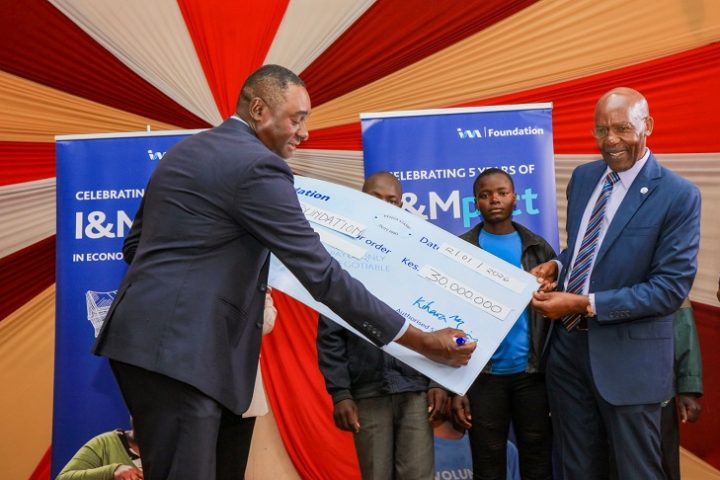
But the the 2% Model championed by the I&M Foundation is a bold reimagination of corporate philanthropy that links philanthropic funding to profits. This innovation transforms giving from a discretionary expense into a sustainable business embedded purpose.
From CSR to Profit-Linked Philanthropy
Traditional CSR in Kenya and across East Africa has typically manifested as sporadic cash donations, event sponsorships, or project funding tied to specific dates (holidays, community festivals, launch events).
While well-intentioned, these initiatives often face three core limitations:
Unpredictability: Annual CSR budgets can be cut, deferred, or redirected based on internal financial pressures, leaving grantees in limbo.
Limited Scale: CSR allocations are often a fixed percentage of revenue or a line item in the budget, insufficient to meaningfully tackle systemic challenges in education, health, or livelihoods.
Shallow Integration: CSR efforts are frequently siloed from core business strategy, leading to disjointed impact and weak operational alignment.
But the I&M Foundation’s 2% Model allocates a fixed 2% of the bank’s after-tax profits to the Foundation’s initiatives every year. This subtle but profound recalibration transforms corporate giving into predictable, sustainable, and strategic funding for long-term social change.
Why the 2% Model Works
1. Predictability and Stability
The I&M Foundation avoids the volatility of traditional CSR budgets. Grantees and social impact partners can plan multi-year interventions, knowing that funding is anchored to a transparent formula rather than arbitrary budget cycles. This predictability fosters trust and enables deeper engagement with communities and stakeholders.
2. Alignment With Business Growth
Because funding grows with profits, the social impact ecosystem expands in tandem with business success. When I&M Bank thrives, so do communities supported by the Foundation. This linkage aligns financial performance with social impact outcomes, encouraging a virtuous cycle where business success and community wellbeing reinforce each other.
3. Strategic Focus and Measurable Outcomes
The I&M Foundation doesn’t simply disperse funds; it targets strategic pillars such as education, health, and livelihoods with measurable objectives. The predictability of the 2% Model enables long-term planning, rigorous monitoring, and adaptive programming that delivers demonstrable results rather than transactional goodwill.
Traditional CSR often runs the risk of being perceived as a “tick-box” exercise, something companies do to enhance their reputation. The 2% Model reframes philanthropy as an integral part of business identity, driven not by compliance or optics but by measurable commitment.
The question now is not just whether this model works for I&M Foundation but whether it can be scaled across sectors and borders. The answer is a resounding yes—with some contextual adaptation:
Multinational Corporations: With established governance structures and profit reporting, multinationals can adopt the 2% Model to harmonize global objectives with local impact.
Large Regional Banks and Insurers: Financial institutions with predictable profit streams are ideally positioned to embed profit-linked philanthropy into their DNA.
Manufacturing and Agribusiness: By allocating a share of net profits to local development funds, these sectors can strengthen supply chains and community resilience.
However, successful adoption requires more than percentage pledges—it demands corporate leadership willing to integrate social impact into core performance indicators, transparent reporting, and stakeholder engagement that goes beyond public relations.
The I&M Foundation’s 2% Model offers a transformative blueprint for sustainable philanthropy in Kenya and East Africa. By rooting giving in profits, it ensures that social impact funding is predictable, scalable, and aligned with business growth. This model challenges corporations to elevate their purpose beyond periodic benevolence toward an enduring partnership with communities. In an era where business success is increasingly defined by social contribution, the 2% Model isn’t just innovative—it’s essential.
Related Content: I&M Foundation Dedicates Ksh 10 Million To Help Communities This Christmas